Optimization of reaction conditions using machine learning
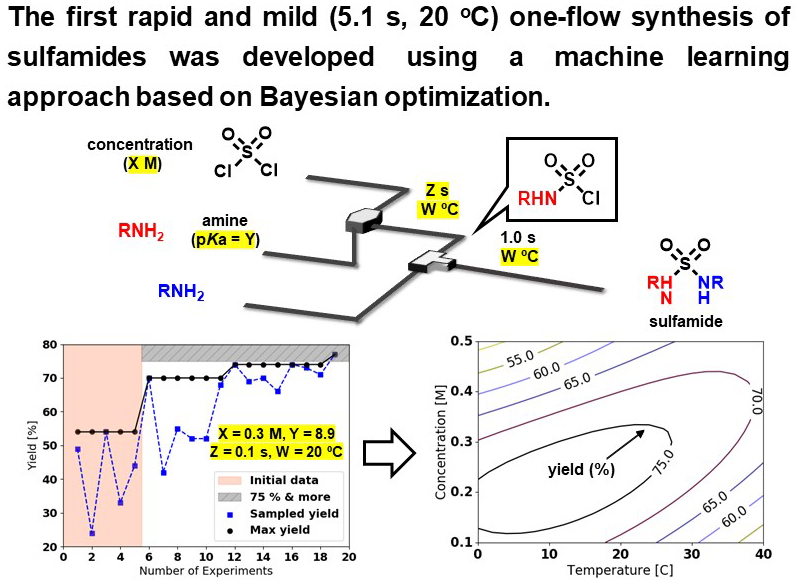
In recent years, efforts to harness machine learning to identify optimal solutions as rapidly as possible have expanded across various fields of science including synthetic organic chemistry. Among these machine-learning approaches, Bayesian optimization (BO) has attracted particular attention as a method capable of efficiently identifying optimal conditions while requiring only a limited number of experiments and minimizing the risk of overlooking the true optimum. In particular, microflow synthesis involves a larger number of adjustable parameters than conventional batch synthesis, making BO especially valuable for reaction condition optimization.
By taking advantage of microflow synthesis, we successfully developed a one-step synthesis of sulfamides—important structural motifs in pharmaceutical lead compounds—from inexpensive, readily available starting materials that generate minimal waste. Notably, this approach effectively suppresses side reactions that have traditionally been difficult to control. Furthermore, by employing BO during reaction condition screening, we could identify the desired conditions while substantially reducing the number of experiments required. Although the parameter space comprised as many as 10,500 possible combinations, BO enabled us to discover the optimal conditions in fewer than 20 experiments. These optimized conditions were subsequently applied to achieve the synthesis of a series of sulfamides.
In addition, we utilized the trained Gaussian process regression model to predict correlations among the reaction parameters. This analysis revealed an unexpected finding: solution viscosity seemed to influenced on reaction outcome significantly. This is a collaborative work with Tokyo Tech, Kanazawa University, and British Columbia University.
Chem. Methods 1, (11), 484-490 (2021).
Mechanistic elucidation of rapid and exothermic reactions through DFT calculations
Organic reactions involving highly reactive intermediates are attractive for the development of efficient chemical processes because they can often proceed rapidly under low-temperature conditions. However, mechanistic investigation of such reactions is frequently challenging. Owing to their extremely fast reaction rates, the key elementary steps are often completed before they can be directly observed. In addition, insufficient heat dissipation can lead to undesired side reactions, making the acquisition of reliable experimental data difficult when conventional batch synthesis methods are employed.
By taking advantage of microflow synthesis technology, we are able to obtain highly reliable and reproducible experimental data for fast and exothermic reactions under precisely controlled reaction conditions. The excellent heat- and mass-transfer characteristics of microflow reactors enable accurate control of highly reactive systems while minimizing the occurrence of side reactions.
Combining these experimental observations with DFT calculations allows us to gain detailed insight into reaction pathways, intermediates, and transition states, thereby facilitating the elucidation of reaction mechanisms at the molecular level. Through the integration of experimental and computational approaches, we aim to establish a deeper understanding of useful fast and exothermic reactions and to uncover the fundamental principles governing their reactivity and selectivity.
Mechanistic elucidation of nucleophilic substitution at electrophilic phosphorus centers by DFT calculations
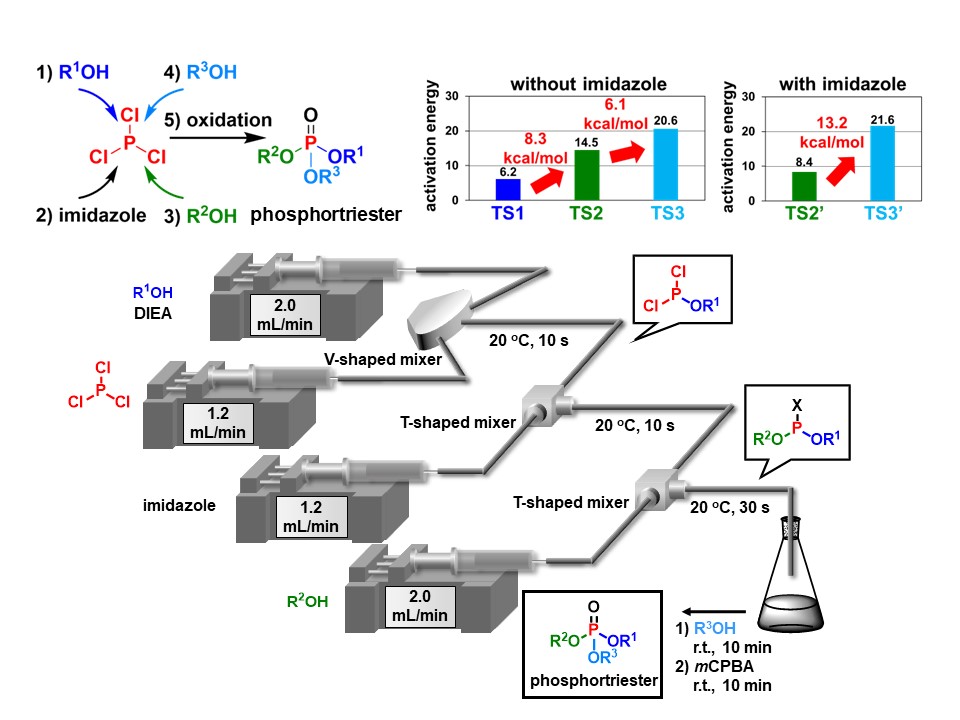
Phosphotriesters are important as intermediates in oligo nucleotide synthesis, prodrugs, drug candidates, pesticides, flame retardants, and plasticizers. Almost all the organophosphorus compounds have been synthesized from inexpensive and readily available phosphorus trichloride. However, it was difficult to synthesize phosphotriesters via sequential introduction of three different alcohols against phosphorus trichloride because over nucleophilic attack of alcohols readily occurs due to high electrophilicity of phosphorous trichloride. Interestingly, the risk of overnucleophilic attack during introduction of the second alcohol is higher than that during introduction of the first alcohol. The addition of imidazole suppress the undesired overnucleophilic attack during introduction of the second alcohol. However, although these are fundamental issues in organophosphorus chemistry, detailed explanations were offered neither for the decreased selectivity in the absence of imidazole and nor for the improved selectivity in the presence of imidazole. We developed micro-flow synthetic approach that enabled rapid synthesis of phosphotriesters via sequential introduction of three different alcohols against phosphorus trichloride. We also proposed reasons for the decreased selectivity in the absence of imidazole and for the improved selectivity in the presence of imidazole based on DFT calculation. This is a collaborative work with Tokyo Tech and Kanazawa university.
Chem. Eur. J. 28, (37), e202200932, (2022).
Elucidating the influence of countercations on stereoselective phosphoramidate synthesis through DFT calculations
In recent years, organic compounds bearing a chiral phosphorus center have attracted considerable attention as pharmaceutical agents, and a variety of synthetic methods have been developed. However, typical approaches require low-temperature conditions and long reaction times, resulting in limited productivity.
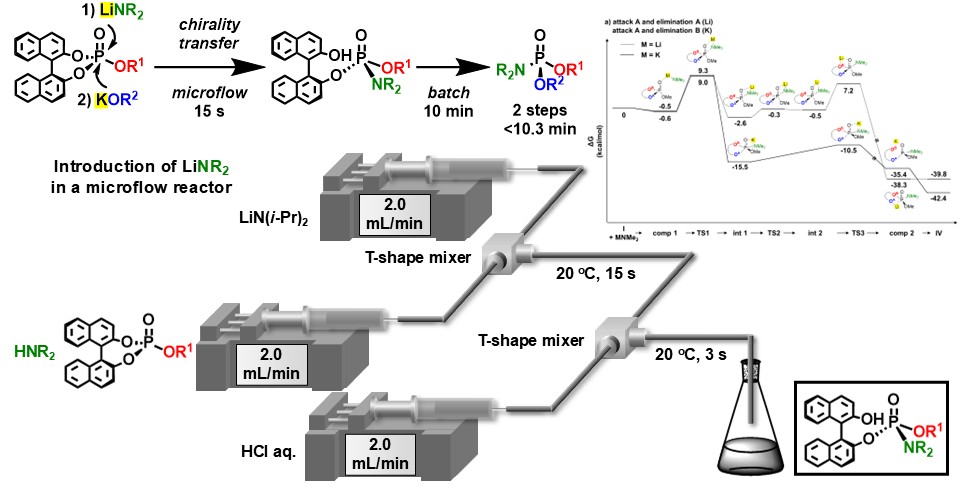
In collaboration with Prof. Dr. Murai of Gifu University, we developed a rapid, highly productive, and scalable synthey based on the transfer of axial chirality from BINOL to central chirality at phosphorus. This approach achieved approximately a 7,800-fold improvement in productivity compared with conventional approaches.
During this study, we observed that the reaction outcome was strongly influenced by the nature of the countercation associated with the nucleophilic anion. To elucidate this phenomenon, we performed DFT calculations and proposed a mechanistic rationale for the observed cation-dependent reactivity.
We have also reported other studies combining machine learning, theoretical calculation, and microflow synthesis!
Development of a microflow amide synthesis using multi-objective Bayesian optimization (in collaboration with Professor Lapkin’s group at the University of Cambridge)
React. Chem. Eng. 9, (3), 706-712, (2024).
Microflow synthesis of asymmetric sulfamides and sulfamate esters. The effect of amines on the reaction was analyzed using machine learning.
Org. Lett. 26, (14), 2739-2744, (2024).
Development of a microflow sequential coupling and cyclization using Bayesian otptimization. The key factors were examined (in collaboration with Dr. Shusaku Asano at Kyushu University).
Bull. Chem. Soc. Jpn. 98, (4), uoaf022, (2025).